Office Hours
Office Location

Hiring Your Spouse in Your Business: Tax Benefits, Payroll Rules, and LLC vs S Corporation Differences

Considering putting your spouse on payroll? Learn the tax advantages, payroll requirements, and key differences between LLCs and S Corporations before making a decision that could impact your family's tax situation.

Introduction

Many business owners eventually ask the same question:

"Should I put my spouse on payroll?"

The answer isn't always straightforward.

In some situations, hiring a spouse can create valuable tax planning opportunities. In others, it may increase payroll taxes, administrative work, and compliance obligations without providing significant benefits.

The right choice depends on several factors, including:

  • Your business structure
  • The work your spouse performs
  • Your family's overall tax situation
  • Retirement planning goals
  • Health insurance considerations

Before adding a spouse to payroll, it's important to understand both the potential advantages and the potential drawbacks.

Can You Hire Your Spouse?

Yes.

A spouse can legitimately work in your business just like any other employee.

Common responsibilities may include:

  • Administrative support
  • Customer service
  • Scheduling
  • Marketing
  • Social media management
  • Payroll assistance
  • Bookkeeping
  • Operations support

As with any employee, the IRS expects:

  • Real work to be performed
  • Reasonable compensation
  • Proper payroll reporting
  • Accurate documentation

Simply paying a spouse without clear duties or payroll records can create problems during an IRS examination.

Potential Benefits of Hiring Your Spouse

When structured properly, employing a spouse may provide several planning opportunities.

Retirement Plan Benefits

One of the biggest advantages may involve retirement savings.

When a spouse receives wages, they may become eligible for:

  • IRA contributions
  • Employer-sponsored retirement plans
  • 401(k) participation
  • Additional retirement savings opportunities

For some families, this can help increase overall retirement contributions while creating long-term financial benefits.

Health Insurance Planning

Depending on the business structure, employing a spouse may open additional options for health insurance planning.

In certain situations, businesses may be able to structure health insurance benefits more efficiently when a spouse is a legitimate employee.

Because these rules can be complex, professional guidance is often helpful.

Income-Shifting Opportunities

In some cases, paying wages to a spouse may help distribute income between spouses.

Depending on the family's tax brackets and financial goals, this can create planning opportunities that may not exist when all income is reported under one spouse.

Potential Downsides of Hiring Your Spouse

While there can be benefits, there are also costs and responsibilities.

Adding a spouse to payroll may create:

  • Payroll tax obligations
  • Additional payroll filings
  • Workers' compensation considerations
  • More bookkeeping requirements
  • Increased administrative work

Many business owners are surprised to learn that payroll taxes can sometimes reduce or eliminate the expected tax savings.

This is why evaluating the entire tax picture is important before making changes.

LLC vs S Corporation: Why Business Structure Matters

One of the most important factors is how the business is taxed.

Single-Member LLC or Sole Proprietorship

If your business operates as a sole proprietorship or single-member LLC, putting your spouse on payroll may sometimes create additional payroll taxes that would not otherwise exist.

In certain situations, alternative planning approaches may be more efficient.

Because every situation is different, running the numbers before adding payroll is often worthwhile.

S Corporation

If the business is taxed as an S Corporation, the spouse is generally treated much more like any other employee.

This typically means:

  • W-2 payroll
  • Payroll tax withholding
  • Employment tax compliance
  • Standard payroll reporting

However, S Corporations may also provide opportunities involving:

  • Retirement plan contributions
  • Employee benefits
  • Health insurance planning
  • Administrative flexibility

The overall outcome depends on the family's specific circumstances.

Should You Add Your Spouse as an Owner Instead?

Sometimes the answer may be yes.

Rather than placing a spouse on payroll, some families choose to make the spouse a co-owner of the business.

Possible options may include:

  • Partnership structures
  • Qualified Joint Venture elections (when available)
  • Multi-member LLC arrangements

Each approach affects:

  • Self-employment taxes
  • Payroll taxes
  • Reporting requirements
  • Retirement planning opportunities
  • Liability considerations

The best option often depends on the family's long-term business and tax goals.

Common Mistakes Business Owners Make

Family payroll arrangements often create problems when documentation is missing.

Some of the most common mistakes include:

  • Paying a spouse without payroll records
  • Using unrealistic salaries
  • Treating personal expenses as wages
  • Ignoring payroll tax requirements
  • Assuming family members are exempt from payroll rules

The IRS expects legitimate employment arrangements regardless of family relationships.

Being married does not eliminate payroll compliance requirements.

Documentation Matters

If your spouse works in the business, documentation should be treated just as seriously as it would be for any other employee.

Important records may include:

  • Job descriptions
  • Time records
  • Payroll reports
  • Payment history
  • Employment agreements
  • Benefit records

Proper documentation helps support the legitimacy of the arrangement and reduces risk during an audit.

Final Thoughts

Hiring a spouse can absolutely make sense in the right situation.

However, a single deduction or tax benefit rarely determines the best strategy.

Business structure, payroll taxes, retirement planning, health insurance considerations, and long-term goals all play a role in determining whether adding a spouse to payroll is beneficial.

The same arrangement that creates tax savings for one family may create unnecessary costs for another.

That is why planning before implementation is often far more valuable than trying to resolve issues later.

Disclaimer

This article is for informational and educational purposes only and should not be considered tax, legal, or financial advice. Family employment rules vary based on business structure, state laws, and individual circumstances. Consult a qualified tax professional before making payroll or ownership decisions involving family members.

Contact Us Today

Thinking about hiring your spouse or changing your business structure? Before adding family members to payroll, it's important to evaluate the full tax impact. 

A proactive review can help identify opportunities, avoid unnecessary payroll taxes, and ensure your business structure supports your long-term financial goals.

Expert Tax and Bookkeeping Insights from Our Team

May 29, 2026
7 min. read
Hiring Your Parents in Your Business: Tax Rules & Payroll Tips
Learn how hiring your parents in your business or for childcare may affect payroll taxes, deductions, and IRS compliance. Understand the rules, benefits, and documentation requirements.
Learn More
May 21, 2026
7 min. read
Can You Hire Your Child in Your Business? Tax Benefits Explained
Hiring your children may create payroll tax savings and other advantages, but IRS rules matter. Learn the requirements, age limits, and common mistakes business owners should avoid.
Learn More
May 15, 2026
6 min. read
Why Rental Property Losses Don’t Always Reduce Your Taxes
Learn how passive activity rules and Real Estate Professional status can completely change the tax treatment of rental property losses, even when the numbers are exactly the same.
Learn More
Tax scam warning concept with fake W-2 and IRS forms
May 8, 2026
6 min. read
IRS Warning About Fake Tax Refund Schemes and False Wages
The IRS is warning taxpayers about false wage and withholding schemes used to generate fake refunds. Learn how these scams work, the risks involved, and how to protect yourself.
Learn More
April 30, 2026
5 min. read
IRS Notice CP53E Explained: Why You Received It and What to Do
Received IRS Notice CP53E? Learn what it means, why you may get it even without a refund, and how to fix your banking details to avoid delays.
Learn More
Woman calculating bills and reviewing tax paperwork at home.
April 25, 2026
5 min. read
Why You Owe Taxes This Year: What a Tax Preparer Can and Cannot Control
Owe taxes this year? Learn the real reasons balances happen, what your tax preparer controls, and how smarter planning can help reduce future tax surprises.
Learn More
Retired couple meeting with financial advisor to discuss retirement planning and taxes.
April 17, 2026
4 min. read
Taxable vs Tax-Deferred vs Tax-Free Accounts Explained
Not all retirement savings are taxed the same. Learn how taxable, tax-deferred, and tax-free accounts work and how to build a smarter, tax-efficient retirement strategy.
Learn More
Woman business owner reviewing IRS letter and calling for help with taxes.
April 10, 2026
4 min. read
IRS Notice Received? What It Means and What To Do
Got a letter from the IRS? Learn why IRS notices are increasing in 2026, what they mean, and how to respond without penalties or stress.
Learn More
March 25, 2026
5 min. read
Should You File a Tax Extension? What Business Owners Need to Know
Filing a tax extension is more common than you think. Learn when it makes sense, how it works, and how it can help you avoid penalties and file more accurately.
Learn More
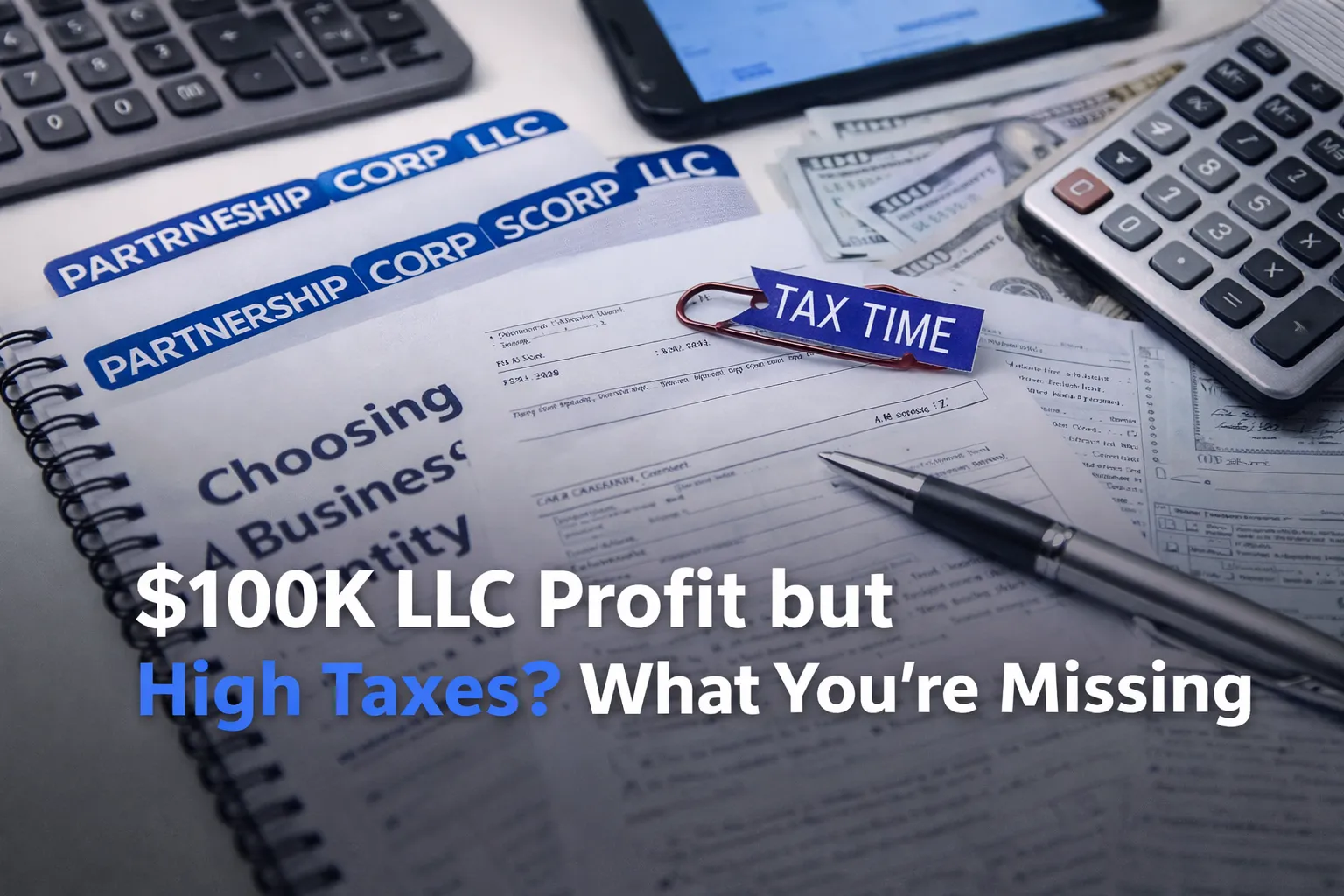
LLC tax planning concept with business entity documents, calculator, cash, and tax time reminder.
March 17, 2026
5 min. read
Smart Tax Planning for LLC Owners: How to Keep More of Your Profit
Making $100,000 in your LLC but losing thousands to self-employment tax? Learn why it happens and how business structure can impact your taxes.
Learn More
LLC structure diagram explaining limited liability company benefits and business setup.
March 10, 2026
5 min. read
LLC Taxation Explained: How LLCs Pay Taxes in the U.S.
Confused about how LLC taxes work? Learn how single-member LLCs, partnerships, S-Corps, and C-Corps are taxed and how to choose the right structure for your business.
Learn More
March 4, 2026
6 mn. read
“No Tax on Tips” 2025–2028: What Service Workers Need to Know
Is tip income really tax-free starting in 2025? Learn how the new federal tip deduction works, who qualifies, income limits, and what it means for tipped employees and small businesses.
Learn More
February 24, 2026
6–7 min. read
Section 179 vs Bonus Depreciation: What Small Businesses Need to Know
Are you considering deducting a vehicle or equipment purchase? Learn how Section 179 and Bonus Depreciation really workand why timing your deductions matters more than you think.
Learn More
Woman writing notes at a desk with desktop computer in a bright home office living space
February 17, 2026
5-6 min. read
Home Office Tax Deduction Explained for Self-Employed Professionals
Working from home? Learn how the IRS home office deduction works, who qualifies, and how to choose between the simplified and regular method to maximize your tax savings.
Learn More
Woman reviewing bills and tax papers at home
February 11, 2026
5 min. read
Estimated Taxes and IRS Penalties: What Triggers Fines?
Think IRS penalties only happen if you miss April 15? Most fines are caused by underpaying taxes during the year. Learn how estimated payments and safe harbor rules protect you.
Learn More
People signing a contract
February 7, 2026
4 min. read
IRS Notice CP28 Explained, What Homeowners Need to Know About Mortgage Interest Limits
Have you received IRS Notice CP28 and are uncertain about its implications? This guide explains why the notice is issued, how mortgage interest deduction limits work, and what homeowners should do next to stay compliant and avoid penalties.
Learn More
Parent and child looking at a laptop together
January 27, 2026
5 min. read
New child investment accounts explained, a tax planning guide for families
Learn how the new federal child investment accounts work, including contribution limits, tax treatment, and planning tips for parents and grandparents.
Learn More
January 22, 2026
4 min. read
Choosing between an IRA, Roth IRA, and 401(k)
Traditional IRA, Roth IRA, or 401(k)? Learn how each account is taxed and how smart tax planning can help you choose the right option for your future.
Learn More
January 14, 2026
3 min read
Are gambling losses still deductible in 2026?
New federal tax rules starting in 2026 limit how much of your gambling losses you can deduct. Learn what’s changing, how the new 90 percent rule works, and what it means for your tax return.
Learn More
Wooden blocks spelling TAX 2026 on table
January 7, 2026
4-5 min. read
Major IRS changes for the 2026 tax season
Tax season is here, and the IRS has introduced important changes that affect refunds, direct deposit, and processing timelines. Learn what’s new for the 2026 tax season and how to avoid unnecessary delays.
Learn More
Girls sports team celebrating with trophy
December 28, 2025
3-4 min. read
How to manage NIL income the smart way
Earning NIL income comes with tax responsibility. This guide explains how to stay compliant, track expenses, and avoid common mistakes without overcomplicating things.
Learn More
HSA health savings account document with glasses and pen
December 17, 2025
4–5 min
How Your HSA Can Become a Tax-Free Money Machine
Your Health Savings Account can do more than pay medical bills. Learn how to use your HSA for long-term, tax-free growth and flexible withdrawals.
Learn More
Small business owner holding tablet in shop
December 10, 2025
3 min. read
Is It Time to Retire Your LLC and Switch to an S-Corp?
As your business grows, an S-Corp may help you save thousands in taxes. Learn when the benefits outweigh the costs and how to tell if you're ready for the switch.
Learn More
November 28, 2025
3–4 min read
Temporary Senior Tax Deduction (2025–2028)
Seniors aged 65+ may qualify for a new temporary tax deduction from 2025–2028. Learn how much you can claim, income limits, and how this benefit works, explained in a simple, clear guide.
Learn More
2025 tax brackets financial documents and reports on office desk
November 19, 2025
6–7 min read
2025 Tax Brackets and What They Mean for You
Want a simple breakdown of the new 2025 tax brackets? This easy guide explains what changed, what stays the same, and how the updates may affect your tax bill.
Learn More
Document to apply foor EIN Number
November 14, 2025
4 min read
Do You Really Need an EIN?
Starting a new business and unsure whether you need an EIN? This guide explains who needs a business tax ID, when to apply, and how to avoid common filing mistakes — with expert tips from our tax professionals.
Learn More
November 11, 2025
5 min read
How Long Should You Keep Your Tax Records?
Unsure which financial records to keep and for how long? Our latest guide breaks down retention timelines for both individuals and businesses — so you can stay compliant and organized this tax season.
Learn More
View All Our Blog Posts

Schedule your consultation to get a professional tax service you can trust

Book a consultation online at your convenience
Book Now
Our Office Location
Regular Office Hours (off-peak)
Monday – Friday: 9:00 AM – 5:00 PM
Saturday & Sunday: by appointment only
Tax Season Hours (Jan – Apr / Filing Period)
Monday – Friday: 8:00 AM – 8:00 PM
Saturday: 9:00 AM – 3:00 PM
Sunday: by appointment only
x
x
Our Office Location